
Gov. Sherrill Says the Right Things About the Shortcomings and High Cost of NJ’s Education System. Will She Take on the NJEA?
May 21, 2026Exxon and Samsung Show High Taxes Hurt NJ While the NJEA-Funded “For The Many” Coalition Pushes for the Highest Taxes in the Nation
June 3, 2026To New Jerseyans who follow our state’s politics, it will come as little surprise that the NJEA was ranked as one of the strongest teachers union in the nation.* According to a new report by the Fordham Institute — updating its 2012 report — New Jersey’s teachers unions ranked as the 4th-strongest in the nation. (Once again, the excellent NJEdReport flagged the Fordham report, and their take on it is worth reading in full). The report measured various aspects of union power, including membership and resources as well as political spending and influence. Nationally, teachers unions have weakened but in blue states like New Jersey, the unions have remained strong. We thought the most salient datapoint was the NJEA’s #1 ranking for dues revenue per teacher. After all, New Jersey teachers have the highest dues in the nation by far, totaling over $1,500 per year, much of which is spent on politics, not representing teachers. Speaking of politics, the Fordham data also confirms the symbiotic relationship between teachers unions and the Democratic Party: blue states are good for teachers unions (if not teachers and students) and teachers unions are good for the Democratic Party. Just like New Jersey.
Here are the specific New Jersey rankings, which are all relative to other states:
Resources and membership: #2. The NJEA does not disclose its actual membership level. On its website, the NJEA claims 200,000 members but for the last few years, leadership has publicly changed that to “nearly” 200,000 members, so we know it’s less than 200,000. Sunlight estimated that from 2018-2023 (the five yers after the 2018 Janus decision) NJEA membership declined about 10%, which put membership in the 180,000-185,000 range. Regardless of the relative #2 ranking, we believe the recent trend for NJEA membership has been down, not up. One area where we are absolutely certain that Fordham is right: dues revenue per teacher is ranked #1 — because New Jersey teachers pay the highest dues in the nation by far, totaling over $1,500 a year.
Involvement in politics: #3. New Jersey is ranked #3 despite the fact that Fordham greatly understates the NJEA’s spending on political campaigns. Fordham measures contributions made directly to candidates and political parties, which are limited by law. It does not measure independent expenditures by Super PACs like the NJEA’s Garden State Forward, which are unlimited and have become the NJEA’s main vehicle for political campaign spending. As an example, the NJEA spent $45 million (of dues) via Super PACs in support of then-NJEA Pres. Sean Spiller’s 2025 run for governor, which is not captured by Fordham. On the other hand, it does appear that the NJEA’s Super PAC’s role has been captured by its political ad spending, which ranks at the very top.
Policy wins and losses: #4. Fordham looked at data like per-pupil spending, charter laws, and teacher evaluations to arrive at its ranking. After two terms of NJEA-friendly Gov. Murphy (“cloying prostration” in NJEdReport’s inimitable phrase), this appears to confirm reality. Notably, the NJEA ranked #16 when it comes to perceived influence. As intended, the NJEA’s Super PAC spending (of dues) is often covert and escapes public notice.
Symbiotic relationship between teachers unions and the Democratic Party. Of particular note was Fordham’s confirmation of the symbiotic relationship between the teachers unions and the Democratic Party on a national level.
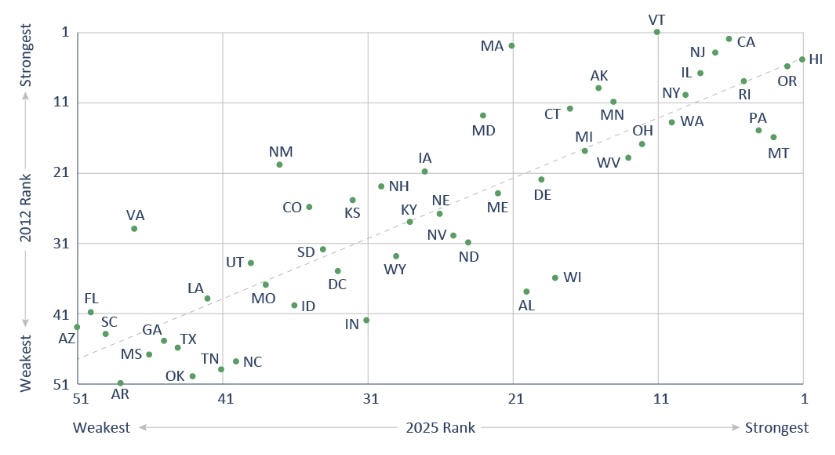
Since 2012, the strongest teachers unions have remained in blue states. Look at the upper right section of the chart below, which combines the rankings from 2012 and 2025: CA, NJ, HI, OR, IL, RI, and NY. All the political branches in these seven states are controlled by Democrats. In other words, Democratic control is good for teachers unions (if not teachers or students).
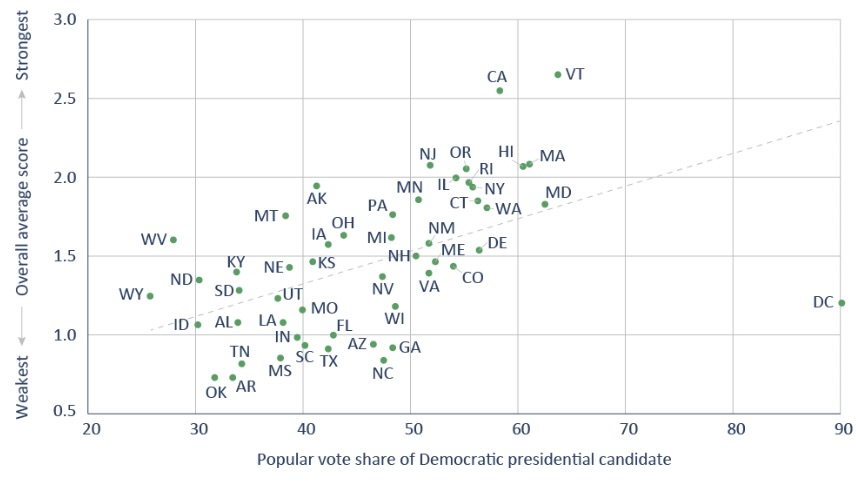
And strong teachers unions are good for the Democratic Party. The chart below combines the strength of unions with the popular vote share of the Democratic presidential candidate. Look at the states above the dotted line and over 50% of the vote: VT, MA, MD, HI, CA, WA, NY, RI, OR, CT, IL, NJ, and MN. The correlation between strong teachers unions and Democratic presidential votes is unmistakable. In other words, strong teachers unions — funded by hundreds of millions of withheld teachers’ dues — are good for the Democratic Party.
All of which is to say that the NJEA plays an outsized role in New Jersey politics — and not just in education. The Fordham report confirms what Sunlight has said for a long time: New Jersey has a special-interest dominated status quo, and the NJEA is New Jersey’s most powerful special interest. If you don’t like the way things are in New Jersey, look no further than the symbiosis between the NJEA and the Democratic Party.
*It is true that the AFT is also present in New Jersey, particularly in Newark, but as a state-level force in politics, the AFT is a distant second to the NJEA.