
In the Aftermath of Gov. Murphy’s Business-Unfriendly Policies, Major Corporations Are Still Fleeing NJ. But Gov. Sherrill Might Be Different.
October 16, 2026Shocker: the NJEA Was Excluded from Gov. Sherrill’s Health Benefits Working Group and Has No Seat at the Table for Its Main Political Priority
October 27, 2026Truth in Accounting (TIA) has published its “Financial State of the States 2026,” the 17th year of the annual study, which measures a state’s total debt and then divides it by the number of taxpayers to arrive at debt per taxpayer. For the second year in a row, New Jersey finished dead last among the states and was one of only four states to earn a “F” grade. New Jersey also has the dubious distinction of finishing in the bottom five states for all 17 years of TIA’s rankings, so the debt problems preceded Murphy, but it is noteworthy that New Jersey received an “F” for every year Gov. Murphy was in office up to FY2025. Even worse, Gov. Murphy squandered post-COVID revenue windfalls by pumping $47 billion of precious dollars into an unreformed pension system while doing little to stem skyrocketing retiree healthcare costs. As a result, he barely moved the needle on New Jersey’s total debt per taxpayer, which is why New Jersey continues to receive “F” grades. Another lousy legacy from Murphy for future governors and taxpayers to clean up.
TIA’s grade is a broader measure of debt than bond agency ratings. TIA analyzes a state’s ability to pay all its debts, including unfunded pension and retiree healthcare liabilities. This stands in stark contrast with bond rating agencies, which only reflect a state’s ability to pay back its bonded debt without considering unfunded pension and healthcare liabilities. Gov. Murphy loudly touted New Jersey’s bond rating agency upgrades but these related to only about a quarter of New Jersey’s total debt (see below).
TIA: New Jersey dead last again with $45,800 of debt per taxpayer. Here are the grim statistics for New Jersey:
- Assets available to pay bills: $56.8 billion
- Total bills: $219.1 billion (including $56.6 billion in bonds; $79.3 billion unfunded pension liabilities; $91.8 billion in unfunded retiree healthcare liabilities)
- Total debt: $162.3 billion
- Total debt per taxpayer: $45,800
Below is a historical graph for debt per taxpayer:
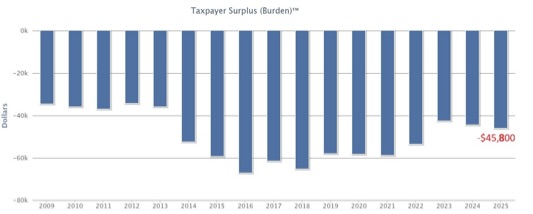
Bottom line: Murphy pumped $47 billion into pensions but barely moved the debt needle. Gov. Murphy used post-COVID revenue windfalls to pump $47 billion into New Jersey’s unreformed pension system, and along with robust investment returns, drove down unfunded pension liabilities. But at the same time, retiree healthcare liabilities skyrocketed so that total debt-per-taxpayer only decreased marginally, from $53,600 in FY2022 to $45,800 in FY2025. As a result, New Jersey still had the largest debt-per-taxpayer burden of any state and received one of the four “F” grades (along with Massachusetts, Connecticut, and Illinois). This underscores how, in an effort to please his government union pals (especially the NJEA), Murphy’s $47 billion neither fixed the pension system — which remains severely underfunded and will require full $7 billion pension payments for another 25 years to be fully funded — nor addressed sharply rising retiree healthcare costs. As the graph above shows, Murphy has left a debt mess for future governors and taxpayers to clean up.
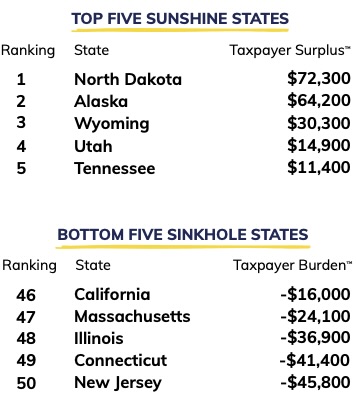
Top five states = red; bottom five states = blue, just like last year. TIA provided the top five “Sunshine” states and the bottom five “Sinkhole” states. The five Sinkhole states are all “blue”: Democrat-controlled, big government states with powerful government unions. The five Sunshine states are all “red”: Republican-controlled, smaller government states with weaker government unions. The rankings are exactly the same as last year’s. Looks like there is a strong correlation between powerful government unions and high debt burdens for taxpayers. Just like New Jersey.
Money is fungible and can only be spent once. Money diverted into pensions cannot be used to mitigate rising retiree healthcare costs or for any other purposes. In the end, the state’s debt level reflects all of the state’s debts, not just pension and bonded debt. Under Murphy, the special interests won but future taxpayers will end up bearing the costs.