
More Optics: NJEA Leadership Launches Campaign to Inform Teachers “How Their Dues Are Spent.” Here Are Some Questions Teachers Should Ask About the Spiller Debacle.
March 17, 2026Why Does NJSpotlight News Ignore Outflow of People and Wealth to Other States? It Was 6th-Worst in the Nation in 2025.
April 2, 2026The Pew Charitable Trusts give New Jersey a very low ranking for its “Rainy Day” reserves, indicating that the state is ill-prepared for any unexpected, future budget crunches. Recent budgets benefited from pandemic-related revenue windfalls, which allowed for budget surpluses, but those surpluses have been halved from $10.7 billion to $5.4 billion (in Sherrill’s FY2027 proposed budget). Such a small surplus would be well below the national median and would leave New Jersey with a thin cushion for an unexpected crisis or economic downturn. That is not sound governance. New Jersey citizens would likely suffer the consequences.
New Jersey has ZERO Rainy Day funds. Kevin Hardy of New Jersey Monitor points out some inconvenient truths unearthed by Pew Charitable Trusts in its analysis of state budget reserves: namely, that New Jersey has “one of the weakest rainy day funds” in the nation. Actually, as Pew shows, New Jersey has the worst rainy day fund in the nation, with a balance of ZERO. Rainy Day funds are reserves that are specifically set aside for unexpected expenses or economic downturns, and lower reserves mean states would have to cut services or raise taxes in a budget crunch. Pew considers such reserves to be a part of sound governance and budgetary practices. Below is Pew’s graph of New Jersey’s Rainy Day fund balances as compared to the national median. As of FY2025 (July 2024 – June 2025), New Jersey’s balance was zero versus the national median of 47.8 days.
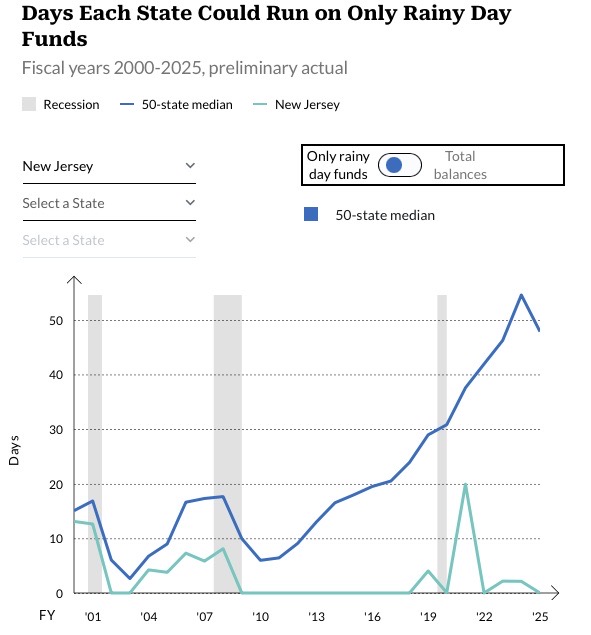
Pandemic-era revenue windfalls create budget surpluses. Like other states, New Jersey’s (temporary) increase in Rainy Day funds came from budget surpluses due to federal pandemic aid and higher-than-expected tax collections from the post-COVID market rebound and higher tax rates imposed by Gov. Murphy.
But Rainy Day funds aren’t the entire picture. Thanks to the above-mentioned revenue windfalls, New Jersey was able to run budget surpluses that have carried over from budget to budget. While these were not “Rainy Day funds” per se, they did provide funds that lawmakers used to plug New Jersey’s perennial structural budget deficits. As shown below, Pew calculated that in FY2025, New Jersey had a total of $8.3 billion in surplus funds, which constituted 52.6 days of spending versus a 91.6 day national median.
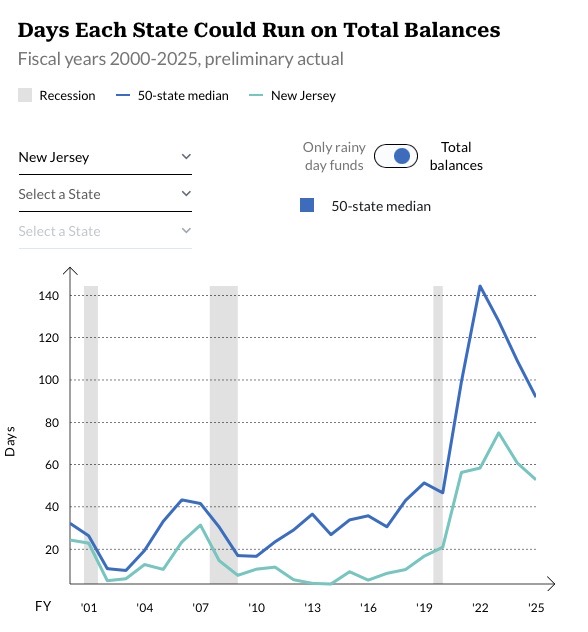
Sherrill’s FY2027 budget: budget surplus now half of peak. Unfortunately, it’s now FY2027, and New Jersey’s budget surpluses have not fared well in the past two budget cycles. At its peak, New Jersey had a $10.7 billion surplus, but that was whittled down to $8.3 billion in FY2025 and Gov. Sherrill proposes to cut it further to $5.4 billion, a reduction by half since the peak. For the record, $5.4 billion would make for a mere 8.9% of the record $60.7 billion FY2027 budget. That equates to about 32 days of spending — far below the 52.6 days in the FY2025 budget and very little cushion for a budget crunch.
But what’s particularly concerning is that Govs. Murphy and Sherrill have used the revenue-windfall surpluses to plug the persistent mismatch between what the state takes in and what it spends. In other words, ordinary budget expenses, not unexpected events or an economic downturn. Pew’s words are prophetic:
Although reserves exist to provide relief during times of fiscal stress, they are not a sustainable solution for persistent budget shortfalls [emphasis added].
The question we must ask Gov. Sherrill and the legislature is: what happens when New Jersey faces an unexpected crisis or economic downturn? Will New Jersey citizens end up suffering more because consecutive governors have frittered away all the surpluses?