
Take Note, Gov. Sherrill: Since FY2022, NJ’s Long-Term Debt Has Flatlined Despite $47 Billion Spent on Pensions
April 28, 2026ELEC Lobbying Report Reveals a Weak, Under-Resourced NJEA Lobbying Effort for Pension Improvement. No Wonder It Failed.
May 7, 2026The ghost of Gov. Murphy comes back to haunt New Jersey. Again. During his two terms, Murphy was always looking for higher tax revenues to fund his 70% increase in state government spending because that’s what his government union pals wanted. Murphy extended the “temporary” 2.5% corporate surtax — and therefore the highest-in-the-nation 11.5% corporate tax rate — for five years, retroactively beginning on January 1, 2024. As New Jersey citizens have seen with their own eyes, numerous large corporations have since migrated out of the state and many of those that remained have been laying off workers. A recent Pew study provides remarkable statistical confirmation of the relationship between these two dynamics. Beginning on January 1, 2024, corporate tax collections plunged below the 15-year tend line and have not recovered. In the 2nd quarter of 2025, they were -15.2% below the trend line, compared to the national average of -2.7%, so New Jersey is a severe underperformer when it comes to corporate tax revenues. Murphy took care of his special-interest political supporters and New Jersey’s economy suffered the negative consequences — and will likely continue to do so.
Corporate tax collections plummet below trend in 1Q 2024. Rarely has there been a graph that captures reality as well as the Pew graph below, which compares New Jersey’s actual corporate income tax collections against their long-term trend line* (where tax collections would be if they continued on their 15-year trajectory).
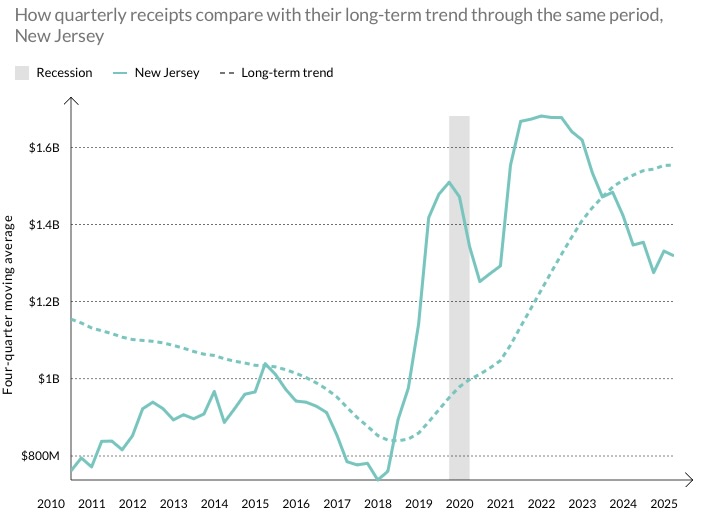
After the above-trend surge during the post-COVID boom, note the sharp downward deviation below the trend line in the 1Q 2024. Here are the numbers:
- 3Q 2023: +0.01%
- 4Q 2023: -0.9%
- 1Q 2024: -6%
- 2Q 2024: -11.9%
- 3Q2024: -12.1%
- 4Q 2024: -17.4%
- 1Q 2025: -14.3%
- 2Q 2025: -15.2%
The numbers show that corporate tax collections were above-trend up until the 3Q and 4Q 2023 (ending December 31, 2023), when they were essentially at the trend line. In 1Q 2024 (beginning January 1, 2024), they started to drop sharply and have stayed well below the trend line until 2Q 2025, when they were -15.2% below. The national average for 2Q 2025 was -2.7%, so New Jersey was a severe underperformer.
Murphy extended New Jersey’s highest-in-the-nation corporate tax beginning on January 1, 2024. It just so happens Gov. Murphy extended the “temporary” 2.5% corporate surtax — and therefore the highest-in-the-nation corporate tax rate of 11.5% — for another five years retroactive to …. January 1, 2024. Coincidence? Perhaps. But every New Jersey citizen has seen the steady outmigration of large corporations from New Jersey as well as the many layoffs by those that remained. We doubt anyone would be surprised to see the Pew numbers align so perfectly with what they have seen with their own eyes.
Just another reminder that Murphy took care of his special-interest political supporters — and his own political fortunes — and left New Jersey citizens to pick up the tab.
*Pew defines the “long-term trend” value as the 15-year linear trend of tax collections leading up to each quarter, after adjusting for inflation and seasonality.