
Truth In Accounting: NJ Dead Last Again, with the Nation’s Highest Debt Per Taxpayer. Seven Years of “F” Grades Under Gov. Murphy.
October 21, 2026We cannot believe we missed this one. Everyone knows there is a crisis at the state-run School Employees’ Health Benefits Plan (SEHBP), with premiums being hiked another 34% this year. Gov. Sherrill’s launched a State Health Benefits Program Reform Working Group (“Working Group”) with 45 different groups asked to participate, including 17 labor organizations representing public employees. A Trenton insider gave Sunlight a heads-up that the NJEA — the largest labor union in the state — was not included in the Working Group. That’s shocking. Recall that, after the $45 million Spiller scandal, political insiders were questioning whether the NJEA had weakened its political influence in Trenton. Then Sherrill did not consult the NJEA on her pick for Education Commissioner. Now, in what is one of the biggest political issues in the state — the skyrocketing cost of health insurance — the NJEA has been excluded from the very Working Group that will furnish the governor with recommendations to reform the system. NJEA leadership has made health benefit reform its main political priority and now the NJEA is not even at the table in Trenton. Current leadership has a lot to answer for.
SEHBP is in crisis. Premiums were raised another 34% this year, as SEHBP continued to experience a “downward spiral:” as SEHBP’s costs continue to increase, more school districts opt to leave SEHBP and self-insure, driving up the costs further for the remaining participants. As it currently stands, two-thirds of school districts have left SEHBP, opting instead to self-insure.
Gov. Sherrill forms a Working Group — without the NJEA. To address this crisis, Gov. Sherrill’s launched a State Health Benefits Program Reform Working Group (the “Working Group”) with 45 different groups asked to participate, including 17 labor organizations representing public employees. The Working Group is tasked with convening:
… organizations representing the State, participating unions, and stakeholders … to build a road map for systemic reform … to get the measurable results that employees, employers, and taxpayers deserve.
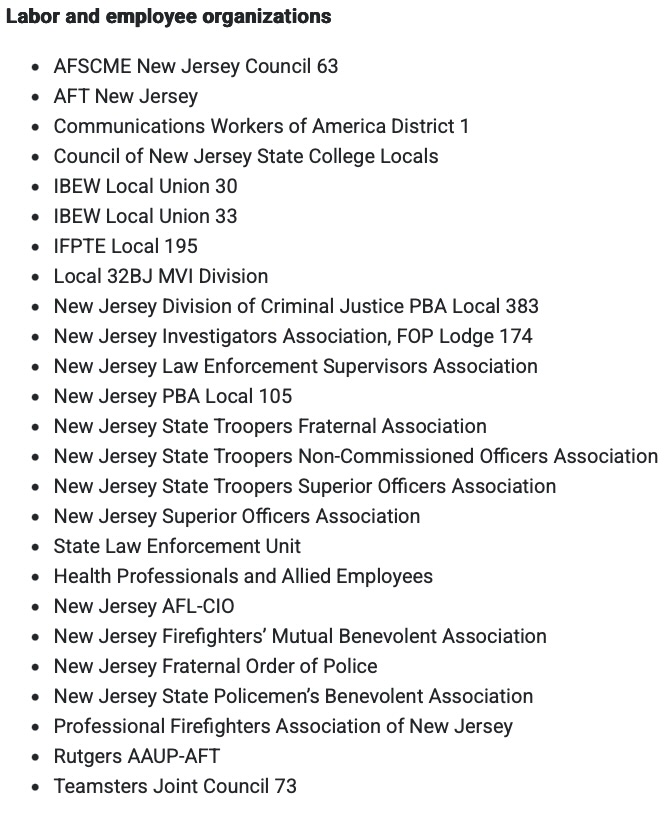
But without the NJEA. Here is a list of the labor unions participating in the Working Group:
Diminished political influence after Spiller’s run. Recall that In the aftermath of the waste of $45 million on former-NJEA President Sean Spiller’s failed run for governor, Politico observed that “some in Trenton are starting to question the union’s political prowess.” The article quoted the chair of the Senate Education Committee, Sen. Vin Gopal:
… I think the strength of the NJEA will be questioned after these election results. How does it not?
Gopal’s words were prescient: in one of the first big education decisions by Sherrill, the NJEA was not consulted on Sherrills’ pick for Education Commissioner. The New Jersey Globe made the connection between the NJEA’s spending $45 million of teachers’ dues on Spiller’s vanity run for governor and the NJEA’s apparent loss of clout:
Sherrill’s pick of Laux came without consulting the New Jersey Education Association, the state’s largest public employee union. The union endorsed Sherrill in September after previously spending roughly $40 million to nominate their own candidate, former Montclair Mayor Sean Spiller, the NJEA president.
NJEA-backed alternative legislation is dead in the water. As we reported recently, we thought the NJEA-backed, Sen. Gopal-sponsored legislation for reforming SEHBP (A5285/S4438) was going nowhere. It would have forced all districts into the state plan while keeping in place the same problematic structure, while reducing the governor’s control over the state plan. With the creation of the NJEA-less Working Group, we believe that bill is dead in the water.
NJEA leadership has made health benefit reform its main political priority, and now the NJEA is not even at the table in Trenton. Current leadership has a lot to answer for.